
Veteran Homelessness Declines Amid National Increases: Lessons in Collaboration and Commitment
While homelessness has been increasing across various areas of the country, one group has shown meaningful progress: veterans. Between 2023 and 2024, veterans were the only population to experience a decrease in homelessness, according to the U.S. Department of Housing and Urban Development (HUD). This progress is the result of years of targeted initiatives, sustained investment, and close collaboration among government agencies. From increased funding to stronger partnerships and a renewed focus on housing as the first step, this approach is making a meaningful difference in the lives of thousands of veterans across the nation.
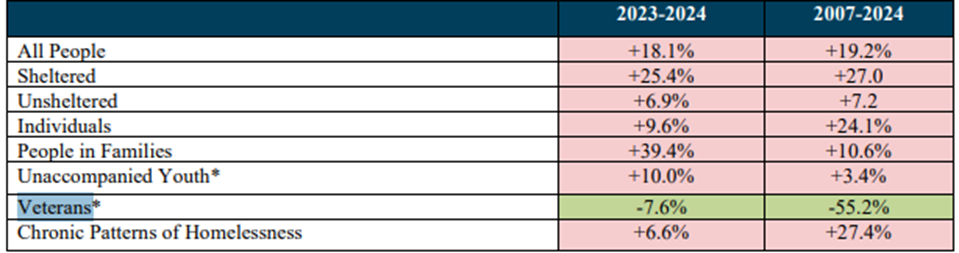
The U.S. Department of Veterans Affairs (VA) made substantial progress in 2024, housing 47,925 veterans in that fiscal year alone. This success can be attributed to several key factors: the VA released $800 million in funding to combat homelessness; the U.S. Interagency Council on Homelessness developed and promoted a plan to proactively address homelessness through prevention; and HUD partnered with the VA to implement policy changes with a renewed focus on connecting veterans to critical resources.
The VA has adopted a “Housing First” model, designed to address homelessness immediately and then build on that stability by connecting individuals to additional support and services. By leaning into this model, the government has bridged the gap between homelessness and the veteran community, fundamentally shifting the narrative around homelessness in cities like Houston.

Other organizations working to reduce homelessness should take note of the success achieved within the veteran community. Funding, interagency collaboration, and a dedication to housing as a foundation for stability have created a model for sustained, year-over-year progress. This formula could be replicated in other communities to achieve similar outcomes and better protect unhoused citizens.
The progress made in reducing veteran homelessness is more than just a success story—it’s a blueprint. When agencies collaborate, invest in long-term solutions, and prioritize housing as the first step, transformational change becomes possible. Communities seeking to address homelessness can learn from this approach: by treating housing as the starting point, we create stability, open doors to essential resources, and give more people the chance to rebuild their lives.
To read more, the U.S. Department of Housing and Urban Development’s (HUD) 2024 report can be found here.


Comments